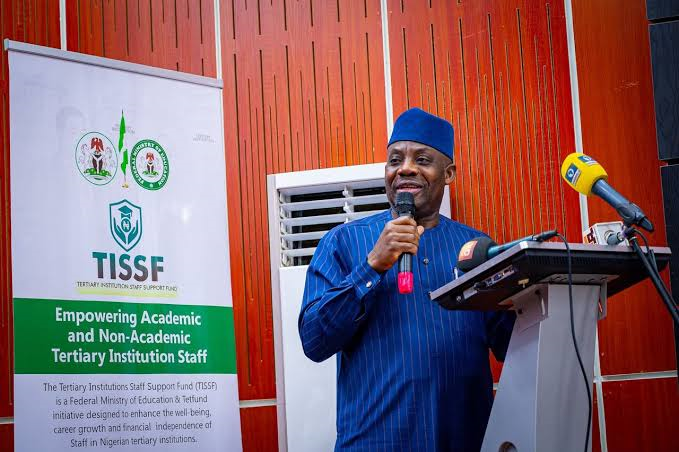
Nigeria’s Minister of Education, Tunji Alausa, has presented the country’s education reform agenda at the Education World Forum in London, outlining efforts aimed at improving foundational literacy and reducing learning poverty.
The minister addressed global education stakeholders during a roundtable session on Monday, where he highlighted reforms being implemented under President Bola Tinubu’s Renewed Hope Agenda.
According to a statement issued in Abuja by the minister’s Special Adviser on Media and Communications, Ikharo Attah, the presentation focused on literacy reforms, data-driven planning and improved education governance.
Alausa revealed that about 80 per cent of donor support for Nigeria’s education sector over the past decade had been concentrated in the North-West and North-East.
However, he noted that both regions still recorded the country’s weakest literacy and numeracy outcomes despite the scale of investment.
He said findings from the Nigerian Education Data Initiative (NEDI) had helped government identify gaps in resource allocation and improve planning.
“We now have the data to redirect resources where they deliver results,” the minister stated.
Alausa explained that Nigeria had adopted a unified framework for foundational literacy and numeracy across both formal and non-formal education systems.
He disclosed that the government was expanding the Rapid Assessment of Numeracy and Literacy programme for lower primary pupils, alongside the Teaching at the Right Level initiative for older primary school learners in 15 states.
The minister also highlighted the role of the Accelerated Basic Education Programme (ABEP), developed by the Nigerian Educational Research and Development Council (NERDC), in helping out-of-school children gain basic literacy and numeracy skills within three years.
According to him, data from both formal and informal learning systems are now integrated into a single national dashboard under NEDI for the first time.
Alausa pointed to programmes such as EKOEXCEL, KwaraLEARN and BayelsaPRIME as evidence that technology-driven education reforms were producing measurable results.
He said KwaraLEARN had reduced foundational learning deficiencies by half in under two years, while BayelsaPRIME recorded a 20 per cent improvement in literacy within 19 weeks.
The minister further disclosed that the Federal Government was finalising a National Policy on Foundational Literacy and Numeracy to strengthen long-term reforms across the education sector.
He added that Nigeria’s funding partnership with the Global Partnership for Education linked approximately 70 per cent of education financing to measurable outcomes in learning achievement, teacher management and data usage.
Alausa also revealed plans to increase the funding allocation of the Universal Basic Education Commission (UBEC) from two per cent to four per cent of the Consolidated Revenue Fund.
He expressed optimism that the ongoing reforms would provide a sustainable foundation for improving literacy nationwide and reducing learning poverty at scale.