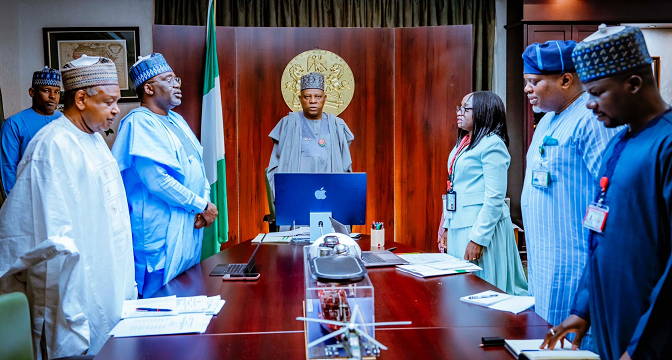
Vice President Kashim Shettima has called for diversified and collaborative funding models to reposition Nigeria’s education sector, insisting that government alone can no longer bear the rising financial burden required to build a competitive and future-ready system.
Shettima made the call on Tuesday in Abuja during the opening of the 2025 Nigeria Education Forum, where he was represented by his Special Adviser on General Duties, Dr. Aliyu Modibo. The forum was organised by the Nigeria Governors’ Forum (NGF), the Federal Ministry of Education, the Committee of States’ Commissioners of Education, and partner organisations.
Describing education as “the ultimate foundation of national stability and progress,” Shettima stressed that sustainable financing must now involve the private sector, alumni communities, industries, philanthropists, local governments, and traditional institutions.
“The country can no longer depend exclusively on traditional models of government-only funding. We must transition towards a system that is collaborative, innovative, and resilient,” he said.
He noted that the forum’s theme, “Pathways to Sustainable Education Financing: Developing a Synergy Between Town and Gown,” underscores the need for a complete rethink of Nigeria’s educational ecosystem.
According to him, the nation’s needs have outgrown basic literacy and now extend to digital competence, industry-aligned skills, well-equipped laboratories, and modernised teaching methods.
FG’s Rising Investment in Education
Shettima highlighted what he described as the Tinubu administration’s increased commitment to education financing, noting significant growth in annual allocations:
₦1.54 trillion in 2023
₦2.18 trillion in 2024
₦3.52 trillion in 2025
He added that key agencies were also receiving strengthened financial support:
TETFund grew from ₦320.3 billion (2023) to ₦683.4 billion (2024) and ₦1.6 trillion (2025).
UBEC expanded its interventions:
25 states and the FCT accessed ₦92.4 billion in matching grants
₦19 billion supported teacher development in 32 states and the FCT
₦1.5 billion reached 1,147 communities
UBE grants increased from ₦1.3 billion to over ₦3.3 billion per state, enabling each to access more than ₦6.6 billion
On tertiary financing, the vice president emphasised the role of the Nigerian Education Loan Fund (NELFUND), established under the 2024 Students’ Loans Act.
“NELFUND has disbursed ₦86.3 billion to more than 450,000 students across 218 tertiary institutions. This signals a new era where no Nigerian is denied tertiary education for lack of money,” he said.
Stakeholders Urged to Share Responsibility
Shettima called for a broad coalition of funders and partners to strengthen the education system. He urged:
Private sector leaders to co-invest in research centres, laboratories, innovation hubs, and endowment funds
Alumni networks and philanthropists to support scholarships and academic development
Local governments and traditional rulers to take ownership of school maintenance, teacher welfare, and security
Industries to collaborate with tertiary institutions to align curricula with market needs
He emphasised that universities must adopt sustainable financial models, deepen alumni engagement, and establish professorial chairs that enhance academic competitiveness.
Out-of-School Children a National Emergency
Addressing Nigeria’s growing number of out-of-school children, Shettima described the situation as a national emergency requiring coordinated action across all levels of government and local communities.
He added that teachers must be adequately trained, properly motivated, and professionally recognised to deliver quality learning outcomes.
He also stressed the need to scale up technical and vocational education to equip youths with marketable skills and reduce socioeconomic vulnerability.
“All these interventions require financing that is predictable, diversified, and sustained,” he said.
A Call for Collective Commitment
Shettima concluded with a call for unity in delivering sustainable reforms across the education sector.
“Through sustained financing and meaningful collaboration between town and gown, we can reshape our educational landscape and prepare our young people for a world defined by innovation and skills,” he said.