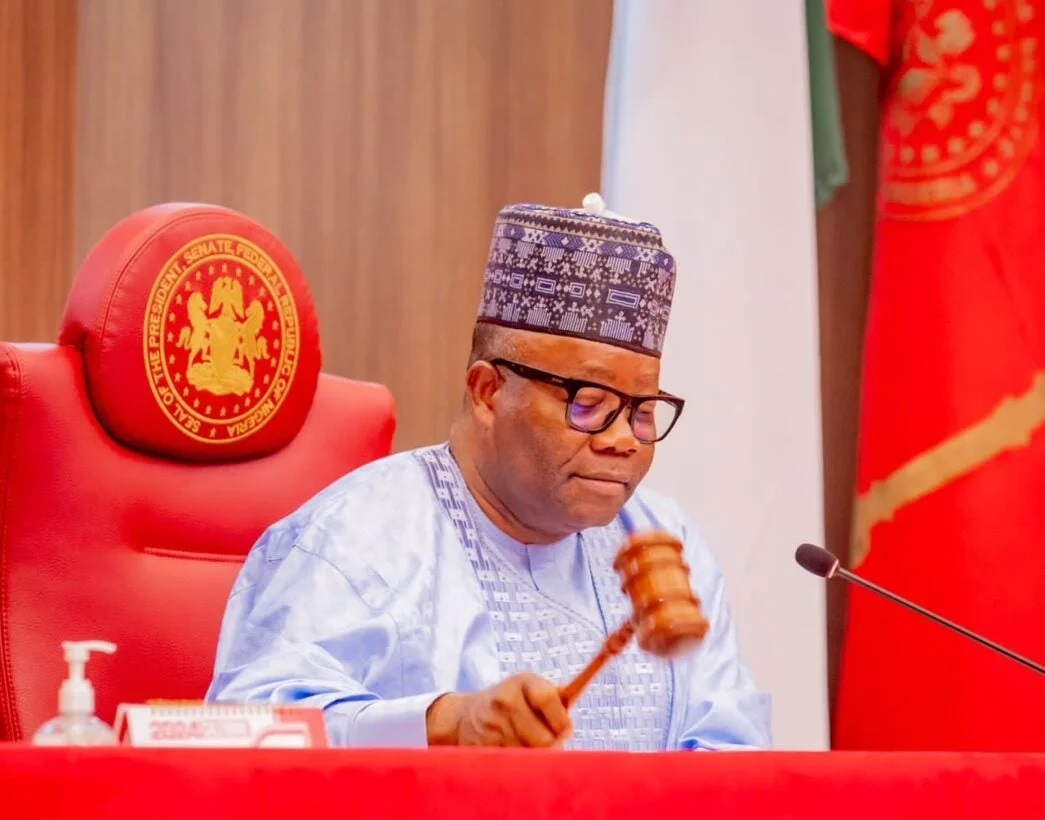
The Senate on Tuesday passed the Electoral Act, 2022 (Repeal and Re-Enactment) Bill, 2026, following a tense and rowdy session marked by heated debates and a division over key provisions of the proposed legislation.
Proceedings in the upper chamber were momentarily stalled as lawmakers commenced clause-by-clause consideration of the bill.
The disruption followed a demand for division on Clause 60 raised by Senator Enyinnaya Abaribe (ADC, Abia South).
Senate President, Senator Godswill Akpabio, who presided over the session, initially stated that he believed the demand for division had earlier been withdrawn.
However, several opposition senators immediately objected, insisting that the matter remained valid and unresolved.
Citing Order 52(6), Deputy Senate President, Senator Barau Jibrin, argued that it would be out of order to revisit any provision on which the Senate President had already ruled.
His submission triggered another uproar in the chamber, during which Senator Sunday Karimi (Kogi West) had a brief verbal exchange with Abaribe.
In an attempt to calm tensions, Senate Leader, Senator Opeyemi Bamidele, (Ekiti Central) reminded lawmakers that he had sponsored a motion for rescission, stressing that decisions previously taken by the Senate on the affected provisions were no longer binding.
He maintained that Abaribe’s demand was consistent with the rescission motion.
Akpabio, however, suggested that the call for division was merely an attempt by Abaribe to publicly register his position before Nigerians.
The Senate President eventually sustained the point of order, prompting Abaribe to rise in protest before being urged to formally move his motion.
Rising under Order 72(1), Abaribe called for a division on Clause 60(3), particularly objecting to the proviso that permits manual transmission of election results in the event of network failure.
He argued that Form EC8A should not serve as the sole basis for collation if electronic transmission fails and pushed for the removal of the clause allowing manual transmission.
During the division, Akpabio directed senators who supported retaining the proviso to stand, followed by those opposed.
Debate also extended to Clause 28, which could result in the scheduling of the 2027 Presidential and National Assembly elections during the Ramadan period.
Lawmakers expressed concern that conducting elections during Ramadan could negatively affect voter turnout, logistical coordination, stakeholder participation, and the overall inclusiveness and credibility of the electoral process.
Additionally, the Senate considered discrepancies identified in the Long Title and several clauses of the bill, including Clauses 6, 9, 10, 22, 23, 28, 29, 32, 42, 47, 51, 60, 62, 64, 65, 73, 77, 86, 87, 89, 93, and 143. The issues reportedly related to cross-referencing errors, serial numbering inconsistencies, and internal drafting gaps within the legislation.
Despite the heated exchanges, the Senate eventually passed the Electoral Act Amendment Bill, 2026.