) The National Civil Society Council of Nigeria (NCSCN) says there is a need for stakeholders to consolidate the gains the Senate has made on the Electoral Act amendment.
Blessing Akinlosotu, Executive Director, NCSCN, who made the appeal while briefing newsmen on Wednesday in Abuja, cautioned protesters against overheating the polity.
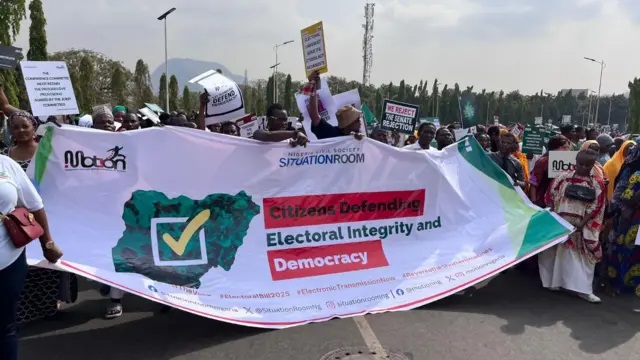
A group of protesters had on Monday gathered at the National Assembly, demanding the inclusion of real-time electronic transmission of election results from polling units in the ongoing Electoral Act amendment process.
The Senate on Tuesday reversed itself and amended clause 60(3) to mandate electronic transmission of results from polling units to IReV after EC8A forms might have been signed and stamped.
The Senate had earlier passed the Electoral Act (amendment) Bill, retaining Clause 60(3) of the principal law, which provided for transfer of results.
Akinlosotu said that senators opposing the real-time upload argued that inconsistent network coverage and logistical challenges could trigger legal disputes and undermine electoral credibility.
He said the senators cited that about 30 per cent rural communities of Nigeria had no networks, and even most urban areas still suffered terrible glitches.
“They further asserted that acking and even breakdown could truncate the entire process going by global menace of cyber insecurity.’’
He said it was important to clarify that the Senate did not reject the electronic transmission of results.
“Electronic transmission remains part of the law, and results will continue to be available to the public both electronically and through physical forms, ensuring verifiable records for disputes.
“What the Senate rejected is mandatory electronic transmission of result in real-time,” Akinlosotu quoted the Chairman of the Senate Committee on Media and Public Affairs, Adeyemi Adaramodu, as saying.
According to Akinlosotu, some democratically advanced countries do not use Real Time Transmission of Election Results.
“Votes are still counted by humans in big democracies, as done in Nigeria; most of them use BVAS and IREV.
“Pakistan and Bangladesh tried to use real time electronic transmission of results but quickly backtracked and returned to manual compilation of election results when massive uproar greeted the process from opposition parties.
“Brazil is the world’s biggest democracy using real time electronic transmission of results, yet almost all its elections conducted using this system is disputed to the Supreme Court.
“Venezuela is using real time electronic transmission of results but Venezuela elections are rated as some of the most fraudulent globally.”
He said that the major actors in the nationwide agitation and protest to the National Assembly were card carrying members of political parties; hence they should not disguise themselves as civil society leaders or activists.
“We may not be where we wish to be yet; however, we must collectively consolidate the gains made so far, rather than overheating the polity and taking steps that may lead to anarchy or breakdown of law and order, as was experienced in the First and Second Republic.
“The council therefore calls on all Civil Society Organisations to dissociate themselves from the ongoing protests,’’ he said.