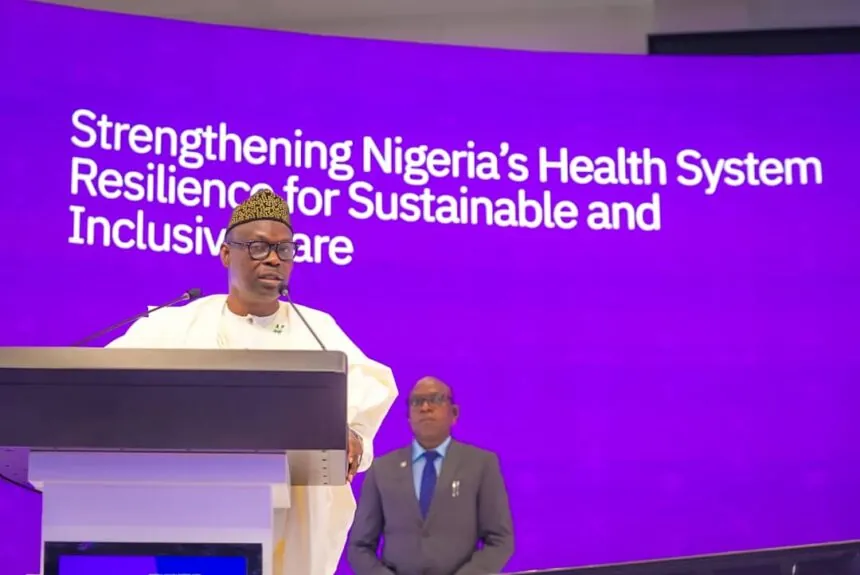
The Federal Government has renewed its commitment to building an inclusive health and social system, with Minister of State for Health and Social Welfare, Dr Iziaq Salako, highlighting the transformative role of art in driving national inclusion.
Salako spoke in Abuja during the Myth Exhibition and Policy Discourse organised by the Kenyeyachukwu Autism Society in partnership with the National Assembly Library. The event celebrated 16-year-old autistic artist, Master Kanyeyachukwu Okeke, whose Guinness World Record–winning piece formed the centrepiece of the exhibition.
The minister said creative expression offered a bridge across communities and cultures, and provided individuals with autism a unique platform to communicate and be understood. He noted that inclusion must be lived daily, not only expressed in policy documents.
“Art invites us to look beyond labels, to embrace difference and to recognise the potential within every Nigerian,” he said. “It holds the power to expand empathy, shift mindsets and drive positive social change.”
Salako affirmed the government’s readiness to advance disability inclusion, mental health support and social welfare initiatives, while acknowledging the Kenyeyachukwu Autism Society as a vital partner in this effort.
Mr Muhammad Sulaiman, National President of the Society of Nigerian Artists Curators, praised Kanyeyachukwu’s work for challenging stereotypes about disability. He said the young artist’s creation, “The Myth Impact,” demonstrated that creativity has no boundaries and that disability often offers a unique perspective rather than a limitation.
Kanyeyachukwu’s father, Mr Tagbo Okeke, said the exhibition was designed to ignite conversations around autism, noting that many children urgently needed therapy and intervention that their families could not afford. He stressed that awareness was essential in tackling stigma, which remained a major barrier for people living with autism.
“We need social structures to support special needs, and we must confront stigma through education and awareness,” he said.