Ali Bello, on Wednesday, tendered the Certified True Copies (CTCs) of a judgment and an enrolled order of Kogi High Court in his defence of allegations that the extra-judicial statements made in the ongoing trial were not voluntarily obtained by the EFCC operatives.
Likewise, Dauda Sulaiman, the 2nd defendant in the alleged N10 billion money laundering case, testified on how he was also allegedly threatened by the EFCC’s investigators to make his statements.
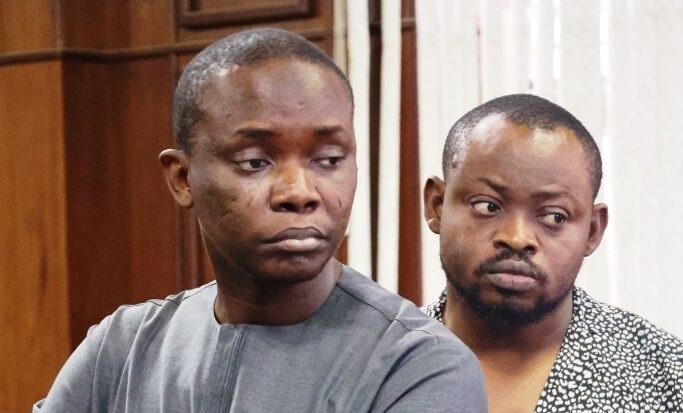
Bello, the Chief of Staff (CoS) to Kogi State government and a nephew of former Gov. Yahaya Bello, tendered the documents through his lawyer, E A. Osayomi, before Justice James Omotosho of the Federal High Court (FHC) in Abuja during the trial-within-trial.
The News Agency of Nigeria (NAN) reports that the hearing was aimed at verifying the defendants’ claim that their statements were obtained under duress during the investigation that led to the trial by the EFCC’s officers.
While Bello is the 1st defendant, Sulaiman is the 2nd defendant in the case.
The charges relate to alleged unlawful activities during the tenure of ex-Gov. Bello, who is also facing two different charges bordering on alleged money laundering at the FHC and FCT High Court.
The duo, through their lawyers, Abubakar Aliyu, SAN, and Olusegun Jolaawo, SAN, had, on Monday, objected to the plan by EFCC’s lawyer, Rotimi Oyedepo, SAN, to tender the eight statements they allegedly made as exhibits while leading Ahmed Audu Abubakar, the 17th prosecution witness (PW-17), in evidence.
While Aliyu, who appeared for Bello, insisted that the six statements made by his client were not made voluntarily, Jolaawo, counsel for Sulaiman, equally told the court that his client was threatened by the commission’s operatives who took his client’s two statements.
However, the EFCC’s lawyer disagreed with the defence submissions and Justice Omotosho ordered a trial-within-trial and directed Abubakar, who is PW-17, to give evidence as PW-1 in the trial-within-trial.
After the anti-graft agency called it three witnesses, Bello and Sulaiman were equally ordered by the judge to open their case in the trial-within-trial.
The Kogi CoS was said to have made those statements on Nov. 29, 2022; Nov. 30, 2022; Dec. 1, 2022; Dec. 10, 2022; Dec. 11, 2022 and Dec. 12, 2022, respectively, while Sulaiman made the two statements on Nov. 30, 2022 and Dec. 1, 2022.
Upon resumed hearing on Wednesday, Osayomi, who appeared for Bello, told the court that they intended to tender some documents to establish their case.
“We are not calling oral evidence my lord,” he said.
The lawyer said the documents were decisions from Kogi State High Court in which the court ordered EFCC to release Bello, while in custody in 2022, but failed to comply.
Sulaiman’s lawyer, Olusegun Jolaawo, SAN, did not object to tendering the documents.
Responding, Oyedepo opposed Osayomi ‘s application.
He argued that the documents sought to be tendered were contentious.
He said in the interest of justice, the judge should not admit them in evidence because he would not be able to cross examine Bello.
Besides, Oyedepo argued that the documents were scanned and printed which is not in compliance with Section 84 of the Evidence Act.
He submitted that the receipt attached was generated earlier in the morning, hence, the documents were inadmissible.
But Osayomi stated that the documents were being tendered by Bello because there is an existence of that order against the evidence of the EFCC witness on Tuesday that there was no such order made.
“I submit that the document was not scanned. It was paid for on 17th of January, 2026.
“And It is the new practice in Kogi that you obtain a copy and pay online,” he said.
Responding, Oyedepo argued that the issues of the Kogi court decision are still ongoing at the Appeal.
According to him, it is trite that public documents can be tendered from the bar, where an issue is not contentious.
The judge, who admitted the two documents as evidence, marked them as Exhibits TWT-DA (Trial-Within-Trial-DA) and TWT-DB, and Bello then closed his case.
Justice Omotosho equally told the prosecution to bring in its own documents if it wishes.
Giving his testimony as DW-1, Sulaiman, who entered the witness box, narrated how he was drafted into the case.
Led in evidence by his lawyer, Jolaawo, Suleiman told the court how he was allegedly forced by the EFCC officials to make a statement involuntarily.
He said on Nov. 30, 2022, he had gone to deliver food and drugs to Bello, who was in custody at EFCC’s office in Jabi, when he was also taken into custody.
“On the 30th day of November, 2022, I went to my cousin and she asked me to take food and drugs to her husband, Ali Bello, who was detained.
“On getting to the security building, I dropped my name and they asked I should drop my phone.
“I told them that my name is Dauda Sulaiman and that I want to give food and BP drugs to Ali Bello who was detained in the building.
“I was there for about an hour and after then, I saw Mr Adamu Yusuf and Audu Abubakar.
“When they saw me, they asked me my name and I said I am Dauda Sulaiman.
“They asked me if I am Daudu and I said no.
“They showed me some documents and asked me if I knew anything about the contents and I said no.
“They showed me a hardcover notebook and I said I don’t know anything about the books.
“They showed me some transactions in the book and asked if I knew anything about it and I said no.
“Mr Adamu then got angry and said my friend, do you think we are playing here? Do you know we have an electric chair here?
“I became very jittery and I said my wife had just given birth. And I said they should do whatever they want to so that I can go home,” he said.
According to him, Mr Adamu asked me to calm down, that if I cooperate with them and do what they ask me to do, they will allow me to go.
Sulaiman said the officers then brought out a paper for him to write a statement.
He alleged that Audu Abubakar dictated to him what to write from the hardcover book until about 9pm.
Jolaawo showed Sulaiman the hardcover note, which he confirmed to be the book.
The DW-1 said the officials then introduced a lawyer, Z.E. Abbas, to him, whom he claimed he did not know him at the time.
He said Abbas endorsed the statement he wrote.
“After which I was taken to the cell where I now met Ali Bello and we ate the food together there. That day was on 30 November, 2022.
“On the 1st of December, 2022, I wrote another one and they reminded that I can be subjected to the electric chair.
“On the third day as usual they usually take me back to the cell where I was until I was arraigned before my lord.
“And I was never in the same room with Ali Bello during the writing of the statement,” he said.
When his lawyer showed him the statements, Sulaiman confirmed them.
Osayomi, who appeared for Bello, and Oyedepo, who represented EFCC, cross-examined Sulaiman before Justice Omotosho adjourned the matter until Feb. 24 at 12noon for adoption of written addresses in the trial-within-trial.