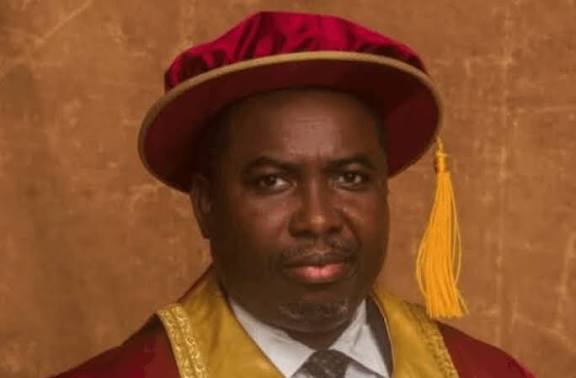
By: Nasiru Jagaba
The recent intervention by the Supreme Council for Shari’ah in Nigeria (SCSN), in which it openly criticised the appointment of the Chairman of the Independent National Electoral Commission (INEC), Professor Joash Ojo Amupitan, and threatened not to recognise any election conducted under his leadership, demands urgent international scrutiny, not applause.
The Council’s objection is not rooted in proven corruption, electoral malpractice, or abuse of office. Rather, its grievance rests on two disturbing grounds: that Professor Amupita is a Northern Christian, and that he has, in the course of his academic and public engagements, written and spoken about the persecution and killing of Christians in Northern Nigeria.
This is not a defence of democracy. It is religious exclusion masquerading as moral authority. For an institution that has consistently failed to confront extremism, religious violence, and systemic discrimination within its own constituency, this attempt to posture as a guardian of Nigeria’s democratic integrity is not only ironic, it is profoundly dishonest and dangerously destabilising.
To the international community, human rights organisations, foreign missions, and democracy-support institutions: this statement is not about theology. It is about power, impunity, selective morality, and institutionalised religious inequality.
THE INEC CHAIRMAN AS A SYMBOLIC TARGET
The SCSN has declared that it will not recognise elections conducted by Professor Joash Ojo Amupitan because of his alleged lack of “integrity,” arising solely from his acknowledgement of Christian suffering in Northern Nigeria. This raises a fundamental question: Is the problem Professor Amupitan’s integrity, or his Christianity?
By this logic, recognising Christian victimhood becomes a disqualifying offence. The message is unmistakable: Northern Christians may serve the state, but must never speak truthfully about their suffering.
Such a position directly violates:
– Nigeria’s constitutional secularism
– Equal citizenship under the law
– International human-rights standards
– The neutrality required of democratic institutions
QUESTIONS THE SCSN CONTINUES TO AVOID
If the SCSN is genuinely concerned about statements capable of inciting religious crisis, its silence in other cases is both revealing and indefensible. Why was the SCSN silent when late President Muhammadu Buhari urged Muslims to vote for Muslims?
Such statements:
– Encourage sectarian voting
– Deepen religious polarisation
– Undermine national cohesion
– Risk inciting religious conflict
Yet Buhari was never condemned. No warning was issued. No legitimacy was questioned. Why?
Why did the SCSN say nothing about the election of Nasir El-Rufai as Governor of Kaduna State? Despite widely reported statements attributed to El-Rufai concerning Jesus Christ and Mary Magdalene, statements that deeply offended Christians and aggravated interfaith tensions, the SCSN raised no moral objection.
Why did integrity suddenly not matter then? Why was the SCSN mute when Professor Isa Ali Pantami was appointed Minister of Communications? Despite Professor Pantami’s well-documented history of violent and extremist rhetoric against Christians, the SCSN:
– Raised no objection
– Expressed no concern
– Declared no legitimacy crisis
But today, a Northern Christian INEC Chairman becomes unacceptable. This pattern is not accidental. It is systemic and ideological.
A PATTERN OF SELECTIVE MORALITY
The SCSN claims to defend:
– Democratic credibility
– National cohesion
– Integrity of institutions
– Equity in appointments
Yet for decades, it has remained silent, or evasive, while Northern Christians are marginalised, attacked, abducted, and killed. This is not an oversight. It is a consistent pattern of selective outrage.
NORTHERN CHRISTIANS: LOYALTY WITHOUT RECIPROCITY
Northern Christians have historically acted in good faith within Nigeria’s fragile pluralism.
Northern Christians supported the Northern People’s Congress (NPC) under Sir Ahmadu Bello and Sir Abubakar Tafawa Balewa until the First Republic was toppled on January 15, 1966.
Northern Christians, led prominently by General T.Y. Danjuma, played a decisive role in the counter-coup that ended the Ironsi regime, not for Christian interests, but to preserve Northern political dominance.
General Yakubu Gowon, a Northern Christian, ruled for nine years. His administration overwhelmingly advanced the interests of Northern Muslims.
At every critical junction, Northern Christians chose regional solidarity over religious identity.
Yet today, Northern Christians are rewarded with:
– Structural exclusion
– Political suspicion
– Religious hostility
– And institutional silence in the face of violence
SYSTEMIC DISCRIMINATION: A DOCUMENTED REALITY
Across much of Northern Nigeria, Christians are treated as second-class citizens. Discrimination manifests in:
– Infrastructure development
– Educational access
– Public service recruitment
– Political appointments
– Security response to attacks
When Northern Muslims are appointed, Northern Christians celebrate in solidarity. When Northern Christians are appointed, sections of Northern Muslim leadership protest, agitate, and delegitimise those appointments on religious grounds.
This hostility is not new. Most appointments given to Northern Christians under President Olusegun Obasanjo and President Goodluck Jonathan were openly criticised by Northern Muslim elites.
These include:
– The appointment of General Martin Agwai
– The appointment of Andrew Yakubu, former Group Managing Director of the NNPC
More recently, the appointment of General Christopher Musa as Chief of Defence Staff, and his subsequent elevation to Minister of Defence, was met with agitation and religiously charged opposition, again, not on competence, but on identity.
Similarly, the backlash against Dr. Maryam Ismaila Keshinro, appointed Federal Permanent Secretary in June 2024, followed the same pattern. Her appointment was opposed not because she was unqualified, but because she is a Northern Christian.
This violates:
– Nigeria’s Constitution
– International human-rights norms
– Fundamental principles of equality and non-discrimination
SILENCE IN THE FACE OF ATROCITY
While the SCSN now speaks loudly on elections, it has been notably silent on Nigeria’s gravest human-rights abuses:
– The abduction and continued captivity of Leah Sharibu
– The lynching and burning of Deborah Yakubu
– Forced abductions, marriages, and conversions of Christians’ teenage girls
– Clerics openly preaching hatred and dehumanisation of Christians
There has been no sustained institutional condemnation, no accountability, and no reform. This silence emboldens extremists.
EXTREMISM: THE REAL TEST AND FAILURE
If the SCSN is serious about national stability, its true challenges are:
– Confronting religious extremism
– Ending hate preaching and online radicalisation
– Addressing terrorism ravaging Northern communities
– Holding Northern elites accountable for decades of underdevelopment
– Restoring trust between Christians and Muslims
Targeting an INEC Chairman does none of these.
SELECTIVE VICTIMHOOD UNDERMINES PEACE
Victimhood cannot be selective. Justice cannot be sectarian. Human rights are indivisible. Denial of Christian suffering fuels instability, not peace.
A MESSAGE TO THE INTERNATIONAL COMMUNITY
Nigeria’s crisis is not merely economic or political. It is institutionalised religious inequality. We urge international actors to scrutinise:
– Religious bodies legitimising exclusion
– Clerical silence enabling extremism
– The shrinking civic space for Northern Christians
OUR POSITION IS CLEAR
Northern Christians are not enemies of Islam. They are not enemies of the North. They are not enemies of Nigeria. They are citizens. Equal citizenship is not negotiable. Human dignity is not conditional. Silence in the face of injustice is not neutrality.
The Supreme Council for Sharia in Nigeria consistently refused to document or publicly condemn the killings, abductions, and rape of Northern Muslims during the administration of President Muhammadu Buhari. Their silence was largely driven by an unwillingness to embarrass a government led by one of their own.
However, the sudden willingness to speak out only emerged after President Bola Tinubu, who is neither from Northern Nigeria nor a Northern Muslim, assumed office. This selective outrage raises serious questions about moral consistency, credibility, and the politicisation of religious advocacy.
Nasiru Jagab
jagabanasiru@gmail.com