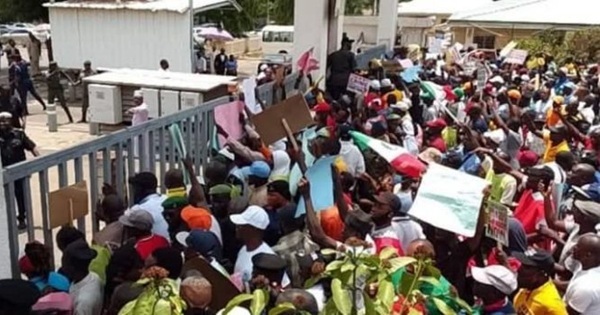
The Minister of the Federal Capital Territory (FCT), Mr Nyesom Wike, has expressed the administration’s readiness for “reasonable dialogue” with striking workers, while warning of legal consequences for those who defy a court order to resume duties.
Wike gave the warning on Tuesday in Abuja while briefing newsmen on the ruling of the National Industrial Court, which ordered an end to the industrial action that has grounded services in the FCTA for over a week.
The minister insisted that the rule of law must prevail, alleging that the strike had been “hijacked by politicians” for purposes unrelated to the welfare of the workforce.
He said that the FCTA approached the court after noticing that mediation efforts were being undermined by external interests, despite the administration addressing a substantial number of the workers’ demands.
“The administration was already in the process of mediation when some politicians hijacked the strike.
“Some of the demands presented by workers were frivolous, unreasonable, or had already been addressed,” Wike said.
He said that the administration remains committed to staff welfare, disclosing that over N12 billion had been approved for the payment of January salaries.
He further highlighted the success of ongoing reforms, noting that the FCT’s Internally Generated Revenue (IGR) had crossed the N30 billion mark, representing a significant increase over previous years.
Wike urged the workers to acknowledge the establishment of the FCT Civil Service Commission and massive infrastructural investments as evidence of his commitment to a functional territory.
He, however, lamented that inefficiencies within the public service often hampered development across the country.
“Workers are largely responsible for the lack of development in states, including the FCT,” he said.
The minister dismissed reports on social media claiming he was chased out of his office by protesting workers, describing the news as “fake.”
“I was never chased out of office. I only stepped out to see President Bola Tinubu off at the airport,” he clarified.
Adopting a firm stance, Wike warned that any further attempt to disrupt government operations or lock premises would be met with the full weight of the law.
“Anyone who dares to lock the gates again will be made a scapegoat, because the law must be obeyed,” he warned.
He alleged that certain senior directors within the civil service were instigating the strike but maintained that the administration would not be deterred from its reform agenda.
Wike also clarified that while the government remains open to talks, it was not mandatory for him to meet with the unions personally.
“Seeing me in person is not a right. Workers’ representatives have been in discussions with management throughout the dispute,” he added.
Wike further directed all staff to resume work immediately in compliance with the court order or face disciplinary and legal actions.
The News Agency of Nigeria (NAN) reports that the National Industrial Court of Nigeria, sitting in Abuja, has granted an interlocutory injunction filed by Wike, and the FCT Administration, compelling workers under the Joint Union Action Congress (JUAC) to suspend their ongoing strike.
The claimants had dragged the Chairman of the Joint Union Action Committee, Rifkatu Iortyer, and its Secretary, Abdullahi Saleh, before the court in suit number NICN/ABJ/17/2026, seeking an order restraining the defendants and their agents from embarking on any industrial action, picketing, or lockout.
Delivering his ruling on Tuesday, Jan. 27, Justice E.D. Subilim held that although the matter before the court amounted to a trade dispute and had met the required legal conditions, the defendants’ right to embark on industrial action was not absolute.
He ruled that workers were prohibited from participating in a strike once a dispute had been referred to the National Industrial Court, adding that where such a strike was already ongoing, it must cease pending the determination of the case.